Bargaining News
|July 16, 2025
Bob Ruhlin’s lifetime of fighting for Maine workers

Bob Ruhlin makes a motion during our 2013 MSEA-SEIU Annual Meeting.
We mourn the passing of Bob Ruhlin, who just marked 6 decades of advocacy as a member-leader of MSEA-SEIU Local 1989
The past few months, Bob Ruhlin wasn’t getting around as much as he used to, but he remained sharp as a whip in his ongoing fight for workers’ rights and quality services in Maine.
Just the other week, Bob, a longtime leader of our union who most recently served as president of our Eastern Maine Retirees Chapter, Zoomed into a meeting of the MSEA-SEIU Retirees Steering Committee as it put the finishing touches on planning our annual MSEA-SEIU Retirees Day – even though he wasn’t able to attend Retirees Day due to health reasons.
At age 82, Bob had done it all with our union in terms of leading the way for workers’ rights, quality services and cultivating the next generation of union leaders and activists. He also had dedicated a lot of his time to building our union as an organization with a structure that will stand the test of time; he had worked tirelessly over the years developing and updating our union’s rules and procedures in our Constitution and By-laws.
Bob’s story with our union went way back. It preceded May 23, 1979, when we signed our first state employee contracts under then-Gov. Joe Brennan, significantly improving the pay, benefits and working conditions of 9,300 state workers. It preceded Oct. 21, 1977, when those contract negotiations began with the administration of then-Gov. Jim Longley. And Bob’s advocacy also preceded the spring of 1974 when MSEA members persuaded the 106th session of the Maine Legislature to approve collective bargaining rights for Maine State Government workers.
Bob passed away on July 11, 2025 – 60 years after beginning his career with what is now known as the Maine Department of Transportation, which was created in 1973 to succeed the Maine State Highway Commission. Bob worked for the State for almost 39 years, starting in 1965 as a draftsman for its Highway and Bridge Project, where he worked for 13 years. Then he worked for 25 years in the State’s Concrete and Testing Lab in Bangor. He retired in 2003 but remained a fixture in our union through his leadership as a retiree member.
According to Bob’s obituary, relatives and friends are invited to share conversation and refreshments from 5 to 7 p.m. Friday, July 18, 2025, at the Family Reception Center of Brookings-Smith, 163 Center St., Bangor.
We had stopped by Bob’s home in Hudson on June 26 to check in with him and chat about our union’s history. We listened as he recalled our fights for collective bargaining rights for state workers and our first state employee contracts.

Bob Ruhlin and MSEA-SEIU Retiree Director Robyn Egan running the retirees’ raffle during our 2023 MSEA-SEIU Annual Meeting.
If you wanted to know how state workers won collective bargaining rights in Maine and what it took to secure our first contracts for state employees, Bob Ruhlin was your go-to. During our visit on June 26, we asked Bob about those fights in the 1970s that culminated in securing our first state employee contracts. They are fights that coincided with our union’s transition from what Bob described as a social club into a real fighting union.
During our interview with Bob on June 26, he said it was either 1972 or 1973 when he attended his first MSEA Convention, or Annual Meeting, where elected delegates gather to decide our union’s course for the coming year and elect union officers, board members and committees. He got to know some of the MSEA elected leaders at the time.
In those early 1970s, Bob saw a real need for MSEA members to get serious about advocating not just for ourselves but also for the services that all state workers provide. He envisioned MSEA being much more than “a chowder and marching society” as he called it back then.
“I was in state service prior to the passage of Maine’s collective bargaining laws in 1974, and I vividly remember how issues were handled – or maybe I should say not handled – back then,” Bob said on June 26. “We had no consistency on crucial everyday issues such as workplace safety between agencies. In many cases, we had no consistency from workplace to workplace even within the same agency.”
Prior to 1974, Bob said, MSEA as an organization acted more like a social club than a union fighting for workers’ rights. In its early years, MSEA sponsored activities like golf tournaments and group vacation trips overseas. “Social is exactly the right term being used prior to the (collective bargaining) law being passed in 1974,” he said of MSEA’s earlier days. “They did some (lobbying) but not anything (like) we did. They’d go over (to the Legislature) begging, but they wouldn’t spend a lot of time fighting. I started out (in 1965) at $1.67 an hour and that was at pay range 13.”

As a longtime leader of our Eastern Maine Retirees Chapter, Bob Ruhlin regularly served as grillmaster during the chapter’s summertime picnics and lobster bakes. He’s shown here in 2012 with former MSEA-SEIU director of field services John Graham Jr.
The turning point, Bob said in our interview, was the fight for collective bargaining rights for state workers, which we won in 1974. “We had a voice. We had to get organized. Even then, we had to defend the union.”
Bob recalled how collective bargaining brought a whole new way of doing business to state workers, management and everyone’s worksites – to ensure that everyone is treated fairly and equally. He called gaining collective bargaining rights for state workers our biggest legislative victory so far.
“Collective bargaining was something brand spanking new and the State was in no hurry to implement it,” Bob said of the years from 1974 to 1979. “Once the law was passed, the State took its time determining which (bargaining) unit you belonged in.”
From our union’s history booklet, The First Fifty Years: “The relationship between public employee labor and management was changing dramatically. Yet, rights granted through the new bargaining law existed only on paper. To become reality, they had to be fought for every step of the way.”
The bargaining unit-determination process for state workers in the 1970s culminated in the establishment of our Executive Branch bargaining units that we know today: Administrative Services; Operations, Maintenance and Support Services; Professional-Technical Services; and Supervisory Services.
Bob recalled that once our bargaining team and management began negotiations in 1977 over terms of our first state employee contracts, management dragged its feet in reaching an agreement. The negotiations started under the Longley administration and continued under the Brennan administration. Gov. Brennan took office in 1979.
By the start of 1979, our first-contract negotiations already had gone through a process known as fact-finding with both sides far apart. Shortly thereafter, under the Brennan administration, the negotiations then went to federal mediation.
ROLLING SICKOUTS
Faced with years of delays and hurdles in the quest for a first state employee contract, workers decided to take matters into their own hands.
“The last week of February (1979), the frustration exploded in a series of one-day sick-outs at worksites across the state,” notes a story in the “Special Contract Edition” of our union’s newspaper, the Maine Stater, published in May of 1979. “The membership had decided it was time to make it clear just how unhappy they were with the lack of progress at the table.”
That edition of the Maine Stater quoted several state workers. One said, “I think it’s difficult to control state employees because of their level of anger. There’s been a very dramatic increase in militancy in the last month because of rising expectations.”
Said another: “Maybe they will realize that we’re tired of being kicked around. It’s time that we stood up for ourselves.”
Rolling sickouts also took place in April 1979 – the same day the Legislature held up a bill relating to our first contracts. “State employees across the state expressed their dismay with the legislative process by leaving their jobs – sick of the way some members of the Legislature were acting,” states a story titled “Politics Stall Contracts” in the May 1979 Maine Stater.
On the rolling sickouts, Bob recalled how the workers in his office in Bangor would call out sick on one day, then workers at the former Bangor Mental Health Institute, now known as Dorothea Dix Psychiatric Center, across the street would call in sick on another day, followed by workers at the Maine Department of Human Services, now known as Maine DHHS, on yet another day.
“It was very effective,” Bob said. “We got that first contract. I think it certainly did” help create the conditions for reaching agreement.
A 24-HOUR STRIKE BY STATE WORKERS FOLLOWED THE SICK-OUTS
The fight wasn’t just about getting the Brennan administration to agree to a first contract. We also had to fight to get legislation relating to the first contract approved by the Maine Legislature. Some members of the Maine Legislature initially blocked that legislation, so MSEA members kept turning up the heat.
Employees began walking off the job one day in May 1979 outraged over the state legislators who were blocking our contract from taking effect, according to a story in the May 1979 “Special Contract Edition” of the Maine Stater. “By the end of that day, thousands of state workers had left their worksites. Late in the afternoon, the State tried unsuccessfully to get a back-to-work order from the courts.”
The following day “was bright and sunny, but the mood in Augusta was grim,” the Stater story notes. “The number of state employees off the job had grown, and picket lines surrounded state buildings. MSEA members had decided that work action was the only way to show their anger at the Republican legislators who were blocking the contract. The demonstration ended around lunchtime when MSEA President Paul Magnusson and Executive Director John Oliver announced that the courts had ordered employees back to work and urged the membership to comply with the order.”
Then, with all state employees back to work and after another round of decision-making by MSEA members, the Legislature finally stopped blocking the contract from taking effect.
In the runup to the 24-hour strike by state workers in May of 1979, Bob recalled, the members of the MSEA Board of Directors gathered one night and began calling members, asking them to make some signs and take to the streets outside their worksites so that other state workers would see the strike on their way to work and join in, which they did. “They thought it was about time they had to do something,” Bob said.
Back in 1979, as is today, state law didn’t provide state workers in Maine with the right to strike, so our members at the time resorted to direct action not just to secure a first contract on terms they could accept but also to persuade the Legislature to stop blocking the contract. To be sure, we have continued fighting for the right for state workers to strike under certain circumstances. In 2019, we testified in support of LD 900, An Act to Expand the Rights of Public Employees under the Maine Labor Laws, providing for state workers the right to strike in some circumstances.
In 2019, as waves of strikes by public school employees and healthcare workers continued sweeping the nation to address low pay, staffing and other critical issues, many MSEA-SEIU members and fellow Maine workers asked their legislators to approve LD 900.
“Across our great nation, teachers are striking to address long-neglected needs of our children, from funding schools to ensuring staffing so every child can get a solid education. Fast-food workers and janitors also are striking to build a better future for themselves and their families. They all know it takes collective action to advocate effectively for each other and the services they provide,” our members wrote in postcards sent to their state senators and state representatives in 2019. “Yet public workers in Maine currently lack that right to strike, leaving them without a critical tool to strengthen public services Mainers count on — services that for years have been understaffed and underfunded. LD 900 will right that wrong by granting certain public workers the right to strike, while exempting those in critical public safety roles.”
From our legislative testimony in support of LD 900 in 2019: “We ask you to create a process for those public sector employees who, in very rare instances, may together decide that exercising their basic human right to withhold ones labor is the only option. Nobody wants to go on strike. It’s an option of last resort when workers have exhausted all other means to defend themselves, their families, and their community.”
However, the 2019 right-to-strike bill died in the Maine House. Then in 2022, Governor Mills vetoed binding-arbitration legislation (LD 677) that we also supported. Governor Mills said she’d veto right-to-strike legislation submitted that year as well, so the right-to-strike legislation also died in the House in 2022. Our fight to strengthen collective bargaining rights through the legislative process continues.
Bob said the rolling sickouts and the strike certainly proved effective in helping to push management to agree to our first state employee contracts and for the Legislature to stop holding them up. Our first contracts included a $15-a-week retroactive payment covering July 1, 1978, through April 1, 1979, and a $16-a-week or 6% pay raise. Those gains were among 50 contractual articles covering everything from mileage to standby pay to overtime, as well as rights relating to grievances, discipline and other areas.
Bob said it’s important for all of us to speak out and engage not just in our union as union members but also in political action, from advocating for or against legislation in the Legislature or Congress, to supporting or opposing candidates for elected office. A Republican, he was a longtime member of our political action program, PASER, Political Action by Service Employees and Retirees. “Politics is a major portion of what we are able to get. There’s a lot of things we’ve gotten through politics” he said, from gaining workers’ rights to funding our contracts to advocating for health and retirement security. “A lot of people don’t see the direct connection. I think it’s extremely important that we stay involved politically and hold their feet to the fire.”
Reflecting on our fight for collective bargaining and our first state employee contracts to the fights we’re in today at both the state and national levels, Bob said he’s hopeful both for the future of our union and our members. “I don’t think we’re in a bad spot as long as the organization is ready to step up, face the challenges and do what’s necessary to do something about it. Based on past history, I guess we’re always going to have to fight.”
A LIFETIME OF SERVICE TO OUR UNION
During his nearly 39 years of work for MaineDOT, Bob served on our Board of Directors from 1977 to 1983 and as a member of our Professional-Technical Services bargaining team every year from 1982 to 2003. He served as president of our union in 1986 and 1987, and as our vice president before that. He decided to run for MSEA president back then because “I just said, I could do a better job.”
Bob always remembered our union’s history as we fight forward. “We have an obligation to those people who met in 1943 to form MSEA,” he said in his president’s address to delegates at our 1987 Annual Meeting. “Their goal was to promote an organization that could be responsive to the needs of the membership. We have that same obligation to our members today. We are strong and meeting our obligations, and cannot afford to do less.”

Bob Ruhlin leads MSEA-SEIU elected delegates in a discussion during our 2016 MSEA-SEIU Annual Meeting.
In retirement, Bob routinely testified in the Maine Legislature in 2011 and thereafter whenever anti-worker legislation came up – yearly during the LePage administration. He consistently led our Eastern Maine Retirees Chapter, serving as chapter president and secretary up until his passing. He served as a retiree director on our Board of Directors. He served on our Retirees Steering Committee, Annual Meeting Committee, and Constitution and By-Laws Committee. Plus, he provided strong support for our next generation of union leaders. Just two years into his retirement, he led a workshop titled “How to Lead Effectively: A Primer for New Leaders and a Refresher for Seasoned Leaders” at one of our leadership conferences.
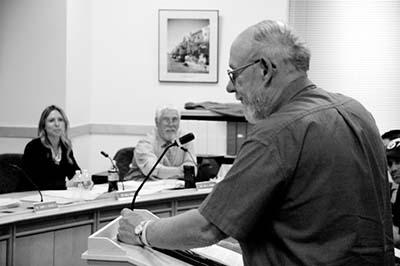
Bob Ruhlin testifying in 2011 against anti-worker legislation during the LePage era.
And in 2023, when it came time to clean out our old union hall at 65 State St., Augusta, and move into our new union hall at 5 Community Drive, Augusta, Bob stepped up daily with his pickup truck and work gloves to help get the job done.
For all of his service to our union over the decades, members of our Retirees Steering Committee named Bob as the recipient of our 2018 MSEA-SEIU Lifetime Achievement Award. The award recognizes those retiree members who have gone above and beyond both as a working member and as a retiree member.
Looking back on his union advocacy, we asked Bob what advice he’d give to the next generation of Maine workers —and he zeroed in on the importance of becoming a union member. “I think I would hand them a copy of the union contract and tell them up until 1974/1979, that everything in that contract did not exist. You’ve got to fight for what you need. Get involved. Go to the meetings. Join the union. There’s a value to belonging to MSEA, and those people will be the ones stepping up, hopefully in scores.”

Bob Ruhlin sharing a moment with fellow MSEA-SEIU Retiree Member Robin Upton-Sukeforth in 2017.