Bargaining News
|March 3, 2026
‘The State’s reliance on low wages is all the more risky and insulting as many state workers face dangerous and traumatic conditions every day’
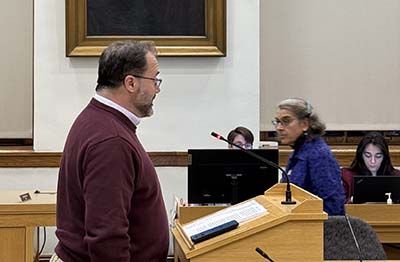
MSEA-SEIU President Mark Brunton testified Feb. 24 before the Maine Legislature’s Appropriations Committee, and State and Local Government Committee, asking them to include funding in the Governor’s proposed supplemental state budget, known as LD 2212, to help close the state employee pay gap. Read his testimony below.
Senator Rotundo, Representative Gattine, members of the Appropriations Committee, Senator Baldacci, Representative Salisbury, members of the State and Local Government Committee, I’m Mark Brunton, president of the Maine Service Employees Association, Local 1989 of the Service Employees International Union. We are a labor union representing over 13,000 Maine workers, including in all three branches of Maine State Government.
We’re here today to express our disappointment that LD 2212 fails to make any progress in closing the state employee pay gap – the difference between what workers in Maine State Government earn compared to their peers in the public and private sectors. We respectfully call on you to do the right thing and include funding in LD 2212 to help close the pay gap.
As you all know, the 132nd Maine Legislature and the Mills administration in 2025 diverted $56 million away from the Salary Plan, which pays wages of state workers, and used that money for other priorities. This raid on the Salary Plan wasn’t a one-time occurrence. Throughout the entirety of the Mills administration, the Legislature has diverted money away from the Salary Plan under the veil of raising the attrition rate for state workers, as well as allocating funds from vacancy savings for capital improvements.
Members of MSEA-SEIU Local 1989 who work for the Executive Branch of Maine State Government have had enough of hearing that there is no funding to solve the persistent recruitment and retention challenges or to address the state employee pay gap, while at the same time seeing the funding from the vacancies used to solve other problems. The overwhelming reason for these vacancies is the lack of competitive compensation compared to similar jobs in municipalities, in other state governments in New England, and in the private sector. These vacancies create a vicious cycle: remaining members absorb crushing workloads, burning out and leaving, which drives even more vacancies. Maine’s public services are unraveling — and the people of Maine are paying the price. That’s why we respectfully ask this committee to restore the $56 million taken from the Salary Plan last year, and to do so as part of the deliberations on LD 2212.
The scheme of increasing the state employee attrition rate to raid the Salary Plan has worsened the recruitment and retention problem throughout Maine State Government. Understaffing throughout all state departments remains a serious problem often with devastating consequences on both state workers and Maine people who rely on their services.
Yet in the wake of the repeated raids on the Salary Plan throughout the Mills administration, the administration now claims it cannot afford anything more than a pair of 2% pay raises for the Executive Branch workers whom we represent. When they made this claim, they specifically cited the impact of the higher attrition rate on the Salary Plan as a reason why. Our members in the Executive Branch have been working without new contracts since July 1, 2025 – that’s nearly eight months. The proposed pay raises from the Mills administration would widen, not shrink, the state employee pay gap because they would put state workers further behind the cost of living. That’s inexcusable.
For almost a decade, we have pressed the Mills administration and the Maine Legislature to reform Maine’s outdated and neglected state employee compensation and classification system. It no longer reflects the work state employees actually perform, the skills required, or the realities of today’s labor market. Three studies, in 2009, 2020 and 2024, show state workers are paid, on average, substantially below both their private and public sector peers. The State’s own study in 2024 put the state employee pay gap at 14% – a 1% improvement over the past five years. The fact is, state workers are falling further behind as they experience Maine’s “affordability” crisis firsthand. Meanwhile, the administration congratulates itself and demands our “thank you” for balancing yet another state budget on our backs.
In December, our bargaining team representing 9,000 state workers declared impasse and sought assistance from the Maine Labor Relations Board through a fact-finding process because the administration offered paltry raises that won’t even keep up with inflation – never mind make any movement on closing the pay gap. The State’s reliance on low wages is all the more risky and insulting as many state workers face dangerous and traumatic conditions every day. Caseworkers, 911 dispatchers, transportation workers, firefighters and psychiatric nurses, witness society’s hardest moments to protect the most vulnerable, often at great personal risk. The recent deaths of our union brothers in MaineDOT have made these dangers painfully clear. As the president of MSEA-SEIU Local 1989, I hear the stories not only from our members but also from their families.
Budgets are statements of priorities. When you’re in a position of power, your character and morals can be reduced to what gets funded or not. There are a lot of needs facing Mainers. It’s not too late for the 132nd Maine Legislature and Governor Mills to do the right thing. In addition to the opportunity to restore the $56 million taken from the Salary Plan last year, this Legislature also has the opportunity to craft a supplemental state budget that ensures millionaires and large corporations pay their fair share and that those revenues are invested in ways that improve the lives of not only our members, but all Mainers. As such, we ask you to reject wasteful tax giveaways for millionaires and wealthy corporations, and instead, focus on raising progressive revenue to fund our current and future needs. As you review the Governor’s proposed supplemental budget, please make the frontline staff – who carry out the laws and programs passed by the Legislature – a priority by dedicating surplus state revenues to help close the state employee pay gap.
A failure to act will only make the pay-gap problem harder and more expensive to solve, and the consequences more tragic. The time is now. Thank you and I’d be glad to answer any questions.