Bargaining News
|March 26, 2026
37 years of patient care at Riverview Psychiatric Center for MSEA-SEIU Member Dr. George Davis
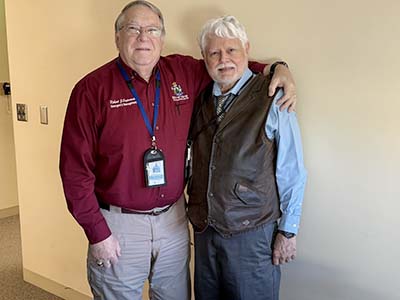
MSEA-SEIU Member Dr. George Davis, at right, a physician for the last 37 years at Riverview Psychiatric Center in Augusta, shares a moment March 18 with fellow MSEA-SEIU Member Bob Patnaude, emergency management coordinator at Riverview, as Dr. Davis approaches his retirement from state service on March 31.
In his 37 years of working as a physician at Riverview Psychiatric Center in Augusta, MSEA-SEIU Member Dr. George Davis has medically evaluated and diagnosed scores of patients admitted to the forensic hospital. In recent years, he typically has admitted six patients a week; he also has participated in patient discharges whenever they’re ready to reenter the community.
“The patients are very complicated,” Dr. Davis said March 18 in an interview at Riverview, adding that he has always remained laser-focused on the patients and their care. “It’s rewarding to see people admitted in terrible shape and leave doing reasonably well. We’re dealing with the most challenging people in the state. Very few people end up in a hospital like this.”
The work of Dr. Davis and his colleagues on the medical team at Riverview is highly documented through the hospital’s intake and outtake requirements and processes. A typical intake of a patient, for example, involves a 2-inch thick binder of papers and forms, he said.
The high volume of paperwork might help explain why Dr. Davis literally started several weeks ago – “and I’m not done yet” – in cleaning out his office in anticipation of his retirement on March 31.
At age 83, Dr. Davis has served as a core part of the medical staff at Riverview for nearly four decades.
A 1968 graduate of Tufts Medical School, Dr. Davis initially ran his own private practice for 19 years, focusing on gastroenterology and internal medicine. In his private practice, he worked 50 to 55 hours a week.
Dr. Jose Castellanos, who served at AMHI and Riverview for 50 years, from 1958 to 2008, mentored Dr. Davis by bringing him on as a consultant at AMHI in 1989. In joining state service in March 1991, Dr. Davis said he was drawn to a 40-hour workweek so he could have time to pursue his passion for independent research. Yet just four months after Dr. Davis joined the AMHI staff, the infamous 1991 State Government Shutdown began on July 1, 1991, in which thousands of state workers were locked out of their jobs without pay and held hostage for 17 days amid the Maine Legislature’s disagreements over the next two-year state budget. Dr. Davis said he worked at AMHI throughout the 1991 shutdown – as did his fellow state workers at institutions like the state psychiatric hospitals and prisons.
Throughout his career in state service, Dr. Davis has worked under five different governors, 18 sessions of the Maine Legislature and a slew of Maine DHHS commissioners and hospital superintendents. His initial work at AMHI began in 1989 – just prior to the implementation of what is known as the 1990 AMHI Consent Decree. The consent decree was a legally binding and enforceable document that remained in force for all but the last two years of Dr. Davis’ tenure at what became Riverview Psychiatric Center.
The decree settled a class-action lawsuit brought by AMHI patients and their families over horrific patient conditions at AMHI prior to 1990. Then, beginning in 1990, former Maine Supreme Judicial Court Chief Daniel Wathen served as the decree’s courtmaster; his job was to ensure that patients received quality care at AMHI and at its successor hospital, Riverview, which was built from 2002 to 2004 when it opened. Wathen also was tasked with ensuring that patients also received the services necessary for transitioning them to community-based care upon their release from the forensic hospital. The consent decree remained in effect until 2024 when the Maine Superior Court terminated it.
The same year the consent decree was terminated, in November 2024, a total of 51 positions, or 25% of the 204 MSEA-SEIU-represented positions at Riverview, were vacant. That actually was an improvement from April 2024 when 64 of MSEA-SEIU-represented positions at Riverveiw were vacant, for a 31% vacancy rate, according to data provided by the Executive Branch of Maine State Government.
While acknowledging the ongoing understaffing and recruitment and retention challenges at Riverview, Dr. Davis described Riverview as an overall stable hospital and he said the implementation and enforcement of the consent decree in the 34 years leading up to 2024 definitely helped improve patient care and conditions at the forensic hospital.
“That’s good for the patients,” Dr. Davis said of the accountability protocols implemented as a result of the consent decree. “I came in when the hospital was in disarray.”
When Dr. Davis started working at AMHI in 1989, the forensic hospital had 400 patients. Currently, as of March 18, it had 68 patients. That’s down from 90 patients around five or six years ago.
“One of the things that has improved is stability. Over the years, the process of admissions and discharges has been more formalized,” Dr. Davis said. He described the social services needed to get discharged patients placed in the community as good. “It’s a constant process.”
Dr. Davis added that the median length of stay for a patient at Riverview is three weeks, although the median stay for a patient deemed not criminally responsible is three years.
Maine has two state psychiatric hospitals: Riverview in Augusta and Dorothea Dix Psychiatric Center in Bangor, but Riverview is the sole forensic hospital in Maine. Forensic hospitals are where patients who are deemed not criminally responsible by Maine’s court system are held until they are ready to reenter the community.
“It makes it challenging in many ways. We’re the only one that provides services at that level,” explained MSEA-SEIU Member Bob Patnaude, the emergency management coordinator at Riverview.
Bob has worked with Dr. Davis for many years. “He is well-respected and very knowledgeable,” Bob said. “He’s been a pillar here. He also helps staff. He’s going to be missed.”
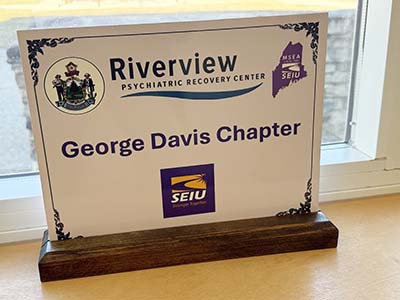
As the president of our union chapter at Riverview, formerly known as the Grace Foster Chapter, Bob said he and our fellow members who work at Riverview wanted to recognize Dr. Davis not just for his many years of service at Riverview but also for his advocacy for hospital services and staff as a member of our union. So, the chapter members voted to rename our union chapter at Riverview as the George Davis Chapter. Members of the chapter will meet under that name on March 31 – Dr. Davis’ last day of work. Dr. Davis rarely missed a union chapter meeting at Riverview throughout his tenure at the hospital, Bob said.
Dr. Davis said it’s more important than ever for state workers, including those at institutions like Riverview, to speak with a united voice in support of the services they provide and in support of each other. He has seen a tug-of-war in healthcare staffing between public and private hospitals over the years. Healthcare conglomerates like Maine Medical Center, he said, can entice workers with signing bonuses – which makes it all the more important for state institutions like Riverview to provide competitive wages. “Working here, it’s (also) tough. Many mental health workers and nurses can work 12-hour shifts,” Dr. Davis said. “That’s a drain.”
Dr. Davis noted that Riverview Psychiatric Center is a central component of Maine’s healthcare structure. Riverview, he said, provides crucial support to hospital emergency rooms statewide as well as to secondary healthcare facilities.
As for his plans for retirement, Dr. Davis said he has none other than to continue his independent research. “I have no bucket list,” he said.
His advice to all of us, after his long career in state service: “If you have an opportunity to learn something every day, you’ll always have a job. Learn outside your comfort zone. It’s important to do something you like every day. Trying different things keeps your brain active.”
He also offered this advice: “Get rid of things that are vexing. I do that ruthlessly.”