Bargaining News
|February 18, 2026
Maine Legislature should help close state employee pay gap by immediately restoring the $56 million taken from the State’s Salary Plan last year
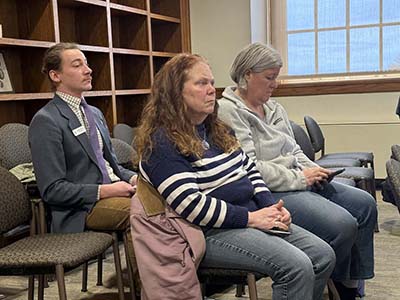
MSEA-SEIU members who work at Riverview Psychiatric Center monitor the start of the legislative hearings on the Governor’s proposed Supplemental Budget known as LD 2212. Below is MSEA-SEIU Director of Politics and Legislation Beth White’s testimony on Feb. 18, 2026, before the Appropriations and Financial Affairs Committee and the Health and Human Services Committee on the need for legislators to include funding necessary to close the state employee pay gap.
By Beth White
Director of Politics and Legislation
MSEA-SEIU Local 1989
We’re here today to testify neither for nor against LD 2212, the Governor’s proposed Supplemental Budget, and to make recommendations for a fair supplemental budget that ensures quality public services for all Maine people and provides state workers with the respect they have earned but long been denied.
First, we support the proposed reclassifications, reorganizations, and range changes in the Governor’s proposed supplemental budget. We also support the creation of new positions at the Maine Center for Disease Control (CDC), the Office of Family Independence, and the Office of Child & Family Services; these positions will be essential for implementing provisions within the federal legislation known as H.R. 1 that passed last year. Many of these offices are already dealing with understaffing even without the increased work created by provisions in H.R. 1.
On a similar note, we support language sections T-12, T-13, and T-14, which provide one-time funding from the budget stabilization fund to pay for technology adjustments and compliance with H.R. 1. This funding will ensure our members have the technology necessary to ensure compliance with H.R. 1.
However, we are disappointed that LD 2212 fails to make any progress in closing the well-documented state employee pay gap – the difference between what workers in Maine State Government make compared to their peers in the public and private sectors. We respectfully call on you to do the right thing and include funding in LD 2212 to help close the pay gap.
As you all know, the 132nd Maine Legislature and the Mills administration in 2025 diverted $56 million away from the Salary Plan, which pays wages of Maine State Government workers, and used that money for other priorities. This raid on the Salary Plan wasn’t a one-time occurrence. Throughout the entirety of the Mills administration, the Maine Legislature has diverted money away from the Salary Plan under the veil of raising the attrition rate for state workers, as well as allocating funds from vacancy savings for capital improvements. Members of MSEA-SEIU Local 1989 who work for the Executive Branch of Maine State Government have had enough of hearing that there is no funding to solve the persistent recruitment and retention challenges or to address the state employee pay gap, while at the same time seeing the funding from the vacancies used to solve other problems. The overwhelming reason for these vacancies is the lack of competitive compensation compared to comparable jobs in municipalities, other state governments in New England, and the private sector. The consequence of these vacancies is more pressure on our members left doing all of the work, including workers at DHHS. Our members are calling on you and your colleagues in the 132nd Maine Legislature to immediately restore the $56 million taken from it last year, and to do so as part of the budget deliberations on LD 2212.
This scheme of increasing the state employee attrition rate to raid the Salary Plan has worsened the recruitment and retention problem throughout Maine State Government. Understaffing throughout all state departments remains a serious problem often with devastating consequences on both state workers and Maine people who rely on their services.Longstanding recruitment and retention issues in Maine State Government have continued, resulting in 1,370 of 9,450—or one in seven—full-time, non-seasonal, and non-temporary positions in MSEA’s four Executive Branch bargaining units vacant as of November 2024, according to data provided by the Executive Branch:
- Riverview Psychiatric Center: 51 positions, or 25% of the 204 MSEA-SEIU-represented permanent and limited period positions, were vacant as of November 2024. That’s actually an improvement from April 2024 when 64 of 204 MSEA-represented positions were vacant, for a 31% vacancy rate. Because of such a high vacancy rate, staff at Riverview have been regularly forced into unsafe encounters with patients. This has frequently led to violent assaults on staff—often with life-changing consequences, including severe traumatic brain injuries. Just yesterday in this room, you heard from MSEA Member Bobbi Bard, an intensive case manager at Riverview. Bobbi Bard said that while she has sensed recent improvements in the overall vacancy rate at Riverview, her team has been down an intensive case manager for a long time. After trying for a year to hire one, they just, did but the new hire won’t start for another month. Bobbi also shared with you that Riverview has been down one of two managers for over a year; that manager position remains vacant. Given the dangerous and violent patient population at Riverview, Bobbi said, and I quote, “it’s pretty important for us to (be) fully staffed in our office, and it’s difficult with the salaries that we’re getting paid to be able to hire and keep competent staff.”
- Dorothea Dix Psychiatric Center: The vacancy rate was 8.5% for MSEA-represented permanent and limited period full-time positions as of November 2024. While this is an improvement from April 2024 when the vacancy rate was at 16%, all of these vacancies at both Dorothea Dix Psychiatric Center and Riverview Psychiatric Center must be filled quickly to ensure quality services and both staff and patient safety.
Throughout Maine DHHS departments like the Centers for Disease Control (CDC), Office of Child and Family Services (OCFS), Office of Family Independence (OFI) and the Office of Aging and Disability Services, we’re also hearing from members who say they remain overworked and understaffed – including Community Care Workers and Human Services Caseworkers at OADS. It’s crucial that Maine DHHS have enough staff to do the job of inspecting and monitoring Maine’s group homes and residential care facilities, for example.
Unmanageable caseloads and impossible workloads also remain real problems for many state workers, including Child Protective Caseworkers at Maine DHHS. There are 13 CPS job postings right now, all within the past week, throughout Maine: Farmington, Skowhegan, Sanford, Rockland, Portland, Machias, Lewiston, Houlton, Ellsworth, Caribou, Biddeford, Bangor and Augusta.
Yet in the wake of its repeated raids on the Salary Plan, the Mills administration now claims it cannot afford anything more than a pair of 2% pay raises for the Executive Branch workers whom we represent. When they made this claim, they specifically cited the impact of the higher attrition rate on the Salary Plan as a reason why. Our members in the Executive Branch have been working without new contracts since July 1, 2025 – that’s over seven months. The proposed pay raises from the Mills administration would widen, not shrink, the state employee pay gap because they would put state workers further behind the cost of living. That’s inexcusable.
For almost a decade, we have pressed the Mills administration and the Maine Legislature to reform Maine’s outdated and neglected state employee compensation and classification system. It no longer reflects the work state employees actually perform, the skills required or the realities of today’s labor market. Three studies, in 2009, 2020 and 2024, show state workers are paid, on average, substantially below both their private and public sector peers. The State’s own study in 2024 put the state employee pay gap at 14% – a 1% improvement over the past five years. The fact is, state workers are falling further behind as they experience Maine’s “affordability” crisis firsthand. Meanwhile, the administration congratulates itself and demands our “thank you” for balancing yet another state budget on our backs.
Budgets are statements of priorities. When you’re in a position of power, your character and morals can be reduced to what gets funded or not. There are a lot of needs facing Mainers. As Maine’s Rainy Day Fund hits its cap and we see a multi-hundred-million-dollar budget surplus, the governor has suddenly decided it’s time to take $200 million out of the Rainy Day Fund now.
It’s not too late for the 132nd Maine Legislature and Governor Mills to do the right thing. As you review the Governor’s supplemental budget, please make the frontline staff – who carry out the laws and programs passed by the Legislature – a priority by dedicating surplus state revenues to help close the state employee pay gap. We recognize there are opportunities in this legislative session to generate revenue to meet such unmet needs, so we also respectfully ask that you show leadership in ensuring that the State of Maine has the revenues necessary for state workers to do their jobs. A failure to act will only make the problem harder and more expensive to solve, and the consequences more tragic. The time is now. Thank you and I’d be glad to answer any questions.