Legislation
|March 3, 2026
Expand the State’s death benefit to include MaineDOT highway maintenance workers
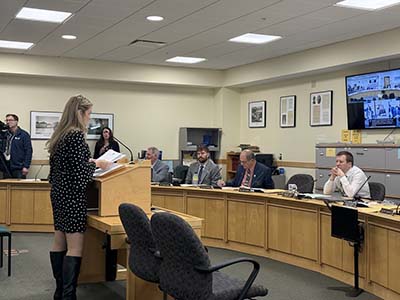
State Rep. Amy Roeder, co-chair of the Maine Legislature’s Labor Committee, today introduced LD 669 expanding the State’s death benefit to include MaineDOT highway maintenance workers. This legislation would be retroactive to Jan. 1, 2026, so that the families of the two MaineDOT workers killed in the line of duty on Jan. 13, 2026, would become eligible for the State’s death benefit.
We testified today in support of LD 669, which would expand the State’s death benefit to include MaineDOT highway maintenance workers retroactive to Jan. 1, 2026. The legislation is in recognition of the on-the-job tragedy that claimed the lives of two of our members earlier this year.
MSEA Member James Brown, age 60, a Transportation Worker III, and MSEA Member Dwayne Campbell, age 51, a Transportation Crew Leader, both of Waterville, died Jan. 13, 2026, doing their jobs for the MaineDOT near mile marker 127 on Interstate 95 in Waterville. According to the National Transportation Safety Board’s preliminary report on the incident, a vehicle entered the interstate without stopping at a temporary stop sign, collided with a tractor-trailer and was pushed into the work zone, striking James Brown, Dwayne Campbell and another worker. James and Dwayne were forced over a bridge railing and fell to the road below. Both died at the scene.
The legislation would amend Title 25, Chapter 195-A to include MaineDOT workers who do highway maintenance work in the job classifications eligible for the death benefit.
In introducing LD 669, Representative Amy Roeder, co-chair of the Maine Legislature’s Labor Committee, read the following statement by MSEA-SEIU Member Tyler J. Brown, a Transportation Crew Leader for the MaineDOT, son of James Brown and stepbrother of Dwayne Campbell:
To the Members of the Maine Legislature’s Labor Committee,
I’m Tyler J. Brown of Waterville and I work as a Transportation Crew Leader for the MaineDOT out of the Fairfield shed. I’m working at my job today and have a lot going on right now with the deaths of my father and stepbrother. So instead of appearing in person today, I’m providing this statement as a private citizen in support of expanding the State’s death benefit to include highway maintenance workers at the MaineDOT.
On the morning of January 13, 2026, I ended up working in Augusta — not the Waterville worksite on Interstate 95. So, I wasn’t there that morning when my Dad, James Brown, and my stepbrother, Dwayne Campbell, were killed on the job.
I literally followed in the footsteps of both my Dad, who joined the DOT back in 2012, and Dwayne, who joined in 2001. I started working for the DOT in November of 2021 as a Transportation Worker and promoted to Transportation Crew Leader three years later, in November 2024.
Out of everybody in my life, my Dad and Dwayne were my mentors. If I needed help, if I needed to get anything off my chest, or if I needed advice, those are the people I would go to. Even now. I’m staying at my Dad’s house. If something breaks, I can’t call him.
Me and Dwayne were close. We didn’t really know each other too much until he came to the Fairfield shed. We obviously knew each other – after my parents divorced when I was 14, my Mom married his dad – but we grew a relationship at the Fairfield shed. We grew really close and gave each other advice.
My Dad, he was my go-to when it came to anything. He and Dwayne weren’t afraid to give me advice even if it’s not what I wanted to hear. They were the two biggest people I was close to in my life and the only people I trusted to go to with anything.
With them gone, at first it was just like everything didn’t feel real. It took me probably a couple days to understand what happened and after that, I just knew that the responsibility of all my Dad’s things, his house, his cars, his payments, his bills, that responsibility was on me. Obviously, I was more than happy to take care of that. Me and my Dad had talked about if anything ever happened, it would be up to me.
Basically when it comes down to this bill on the State’s death benefits, my biggest thing on it would be after a death like this, it kind of just gets thrown into the lap of someone like me, anyone who has to take care of things after the passing of someone in the family. It’s just the hardships that come with it, trying to pay all the bills, trying to make sure things stay afloat. I was already living paycheck to paycheck before all of this. Now, I’m also having to pay for all my Dad’s things. It’s not easy. Everything costs money.
Here’s what the State has done so far for us. The State did end up giving each family a $4,000 check to cover funeral costs. My portion of that check, the whole $4,000, went toward my Dad being cremated because that’s what he wanted, and everything that came with that, the box I chose. The State also said that once estate representatives are named, they will send each family a $3,000 check. So, the total State payments will be $7,000 per family.
In terms of taking time off to grieve, the State provided me with 40 hours of bereavement for my Dad and 40 hours of bereavement for Dwayne – all as required by my union contract. The bereavement time was super-helpful, but the first week was basically trying to figure everything out, gathering paperwork, bills, doing as much as I could do moving forward. The second week was more me, kind of just taking some time. I still have 16 hours of bereavement time. I came back a day and a half early. I wanted to keep myself busy.
But when it comes down to bills and stuff like that, I’ve had to pay for everything. I recently started paying for Dad’s CMP, anything that I found that I had access to and an account number for. I made those phone calls and started making those payments. There’s a couple I didn’t have account numbers for, so I had to say, hey, I’m going to pay $100 toward this; just don’t shut off the electricity. I can’t do much with that until I’m appointed representative of the estate – I have a meeting next week. I’m taking care of Dad’s house. It’s been really cold this past month. I’ve had to keep his pellet stove running. That’s in addition to maintaining my own apartment. I basically haven’t been to my apartment at all, just making sure the pipes don’t burst. I recently got his heating switched over to my name with Irving so we can get refills.
I think the biggest point would be, for me, and I’m sure I could speak for Dwayne’s family, too, is that even with my bereavement leave, none of us really felt like we had time to grieve. When someone dies, money is always going to be a factor, bills still need to be paid, things still need to be taken care of. If the State’s death benefit were amended to include highway maintenance workers like my Dad and Dwayne, that would be a huge benefit to have things covered. It would give us time to grieve and have that safety net. Thank you for taking the time to hear my story.
In her testimony, Representative Roeder said LD 669 is an important step in acknowledging that some jobs carry a higher risk of injury and death.
“Acknowledging that these risks are real and directly associated with this line of work is essential for those who put their lives on the line every day to maintain our transportation infrastructure and keep our roads safe,” Representative Roeder told the Labor Committee. “Here in Maine, we can support our MaineDOT workers and their loved ones by changing the statute to reflect this reality and offering some compensation for the family members who are left behind. More is certainly needed, and I am committed to continuing to work toward better prevention and management solutions.”
In our testimony in support of LD 669, MSEA-SEIU Executive Director Alec Maydarduk noted the origins of the State’s death benefit law go back to legislation that came before the Labor Committee in 2001; the law provided law enforcement officers, firefighters and emergency medical services persons who die in the line of duty with a $50,000 benefit paid to identified survivors as defined in statute. This law was expanded in 2005 to include the roles of judicial marshals, forest rangers, detectives and certain security personnel.
In 2020, LD 2044 was signed into law, adding Emergency Services personnel and Corrections Officers to the death benefit, increasing the death benefit to $100,000 and indexing it to inflation. The changes to the death benefit in 2020, which we strongly supported, were prompted by the prior deaths of Maine firefighters and police officers.
Alec Maybarduk recalled that in introducing the change-in-benefits legislation in 2020, former State Rep. Kent Ackley put it this way: “These are the people — professionals and volunteers alike — who have the backs of the citizens of Maine when we are in harm’s way. These are inherently risky jobs. This bill is about ensuring that every Maine first responder knows that if, God forbid, they pay the ultimate price in the line of duty — a duty performed for our benefit — that the citizens of Maine have their backs.”
Alec Maybarduk said MaineDOT workers perform highway maintenance work and bridge work, and they routinely plow highways for more than 24 hours straight to keep all of us safe and to keep Maine’s economy moving. Maine’s transportation workers are among the first responders to highway accidents, securing the scene for their fellow first responders. “We recognize that technical adjustments may be needed to ensure all at-risk MaineDOT workers are properly covered and that retroactivity language is clear,” he added. “We are committed to working quickly with the committee and stakeholders to address those details. Additionally, if the committee is so willing, we would also welcome including Maine Turnpike Authority workers whose duties closely mirror those of MaineDOT highway maintenance employees.”
MSEA-SEIU Field Representative Tony Baker, who previously worked for MaineDOT for nearly 10 years, also testified in support of LD 669.
“I personally have had many near-miss incidents; I am lucky to be here today. I have had many vehicles not stop while flagging on the roadway,” Tony Baker told the Labor Committee. “In one instance in particular, I was fortunate that I was able to dive into the ditch and avoid being hit. I have had to avoid items falling off of passing trucks and I have also been hit by mirrors of vehicles that were driving by because the driver thought it was funny or was not paying attention. What I am getting at is simple: It does not matter the extent of the safety precautions or a perfect work zone setup. These employees are at the mercy of the general public when they are on the road and they put their lives at risk every day when they go to work. The best they can hope for is that the general public is paying attention when passing by, so that way they can go home uninjured at night.”
Continuing, Tony Baker said, “Nothing can be done to bring back the lives that have been lost, but amending LD 669 is one thing to help ease some of the burden on the families involved and, heaven forbid, any future families. The accident that happened has and will always be one of the biggest fears of all MaineDOT employees. It does not matter if you knew the employees or not; it has shaken all MaineDOT employees and the community.”
Also testifying in support was MSEA-SEIU Field Representative Robin Upton-Sukeforth, who is married to a MaineDOT worker. “The January 2026 deaths of two DOT employees was a tragedy that demonstrates the inherent danger of working road construction,” she told the committee. “It is a reminder that when I kiss my husband as he leaves for his job, my goodbye and wish to be safe is more than rote. It is a reminder of the danger he faces in the next eight-plus hours.”
On behalf of the MaineDOT and the Mills administration, Robert McFerren of the MaineDOT testified in support of LD 669 and encouraged the Labor Committee to cast a wider net with the legislation, a recommendation that we appreciate and support. “We recognize that Maine DOT employees are not the only state workers whose duties place their lives and safety at risk. It could be reasonably argued that employees in other Maine State Government departments face comparable hazards and may warrant similar consideration,” Robert McFerren told the Labor Committee. “We encourage the Committee to reflect on this broader principle as it evaluates how best to structure and apply these important protections.”
Also testifying in support of LD 669 was Adam Goode, legislative and political director for the Maine AFL-CIO. “Highway maintenance workers do dangerous jobs that serve the public benefit,” Adam Goode said. “These workers have families and should not be left in financial ruin when tragedy strikes. We ask that you support LD 669.”